Should-Cost Modeling for Data Center Components: Which of the Four Cost Buckets Dominates, and Why
Summary
Should-cost modeling breaks every manufactured data center component’s cost into four buckets: material, labor and machine time, tooling amortization, and yield. Which bucket is largest depends on the process and the volume. High-volume casting, stamping, and extrusion are material-dominant once tooling is amortized. CNC machining and fabrication are dominated by labor and machine time. Low-volume hard-tooled parts are dominated by amortization. Yield rarely appears on a quote, yet it responds directly to tolerances, wall thickness, draft, and finish requirements on your drawing. Breaking the quote into those four buckets helps you test the price, see what’s driving it, and focus negotiations on the cost levers you can realistically influence.
KEY TAKEAWAYS
ARTICLE
What if the biggest number on a supplier quote isn’t the cost you should be negotiating?
The answer depends on what’s underneath the number.
Two data center components can have similar piece prices and completely different cost structures underneath them.
One may be driven mostly by copper. Another by machine time. A low-volume casting may be carrying far more tooling cost than material cost, while a difficult tolerance or finish callout can push scrap into the piece price.
Copper is a good example because part of its cost is hiding in plain sight. The commodity price is public, and tariffs are known inputs. Copper sold for about $14,500 per metric ton on the London Metal Exchange at the end of August 2026. Since April 6, 2026, Section 232 tariffs have applied 50% to the full value of semi-finished copper imports and 25% to copper-intensive derivative products.
If you’re sourcing copper busbar or another copper-intensive data center component, you have a benchmark for a significant piece of the material cost. What you can’t see nearly as easily is how much of the quote comes from machine time, tooling, scrap, or the requirements on the drawing.
That’s where should-cost modeling becomes useful. It separates those drivers so you can understand what’s putting pressure on cost, test the assumptions behind the quote, and see where you may have room to influence the outcome.
What Are the 4 Cost Buckets in a Should-Cost Model?
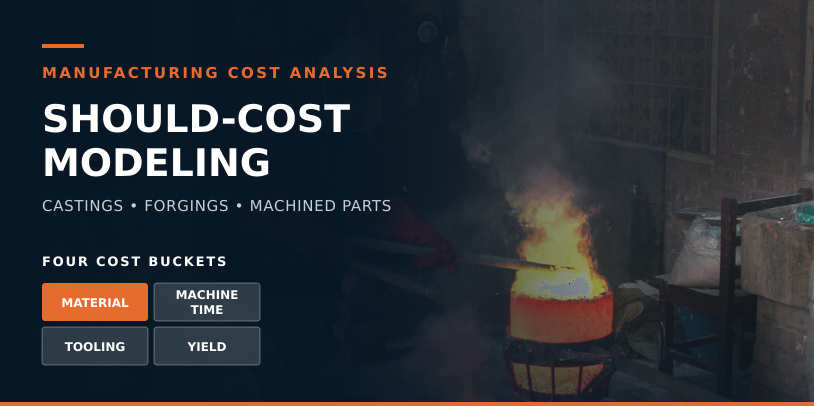
Every manufactured part can be broken into four basic cost buckets:
- Material: the alloy or raw material, plus the built-in scrap allowance
- Labor and machine time: cycle time multiplied by the hourly labor or machine rate
- Tooling amortization: the cost of tooling, including fixtures, trim tooling and gauges, spread across the expected production volume
- Yield: the percentage of parts that pass inspection and become a saleable product
Most supplier quotes show material, labor or machine time, and tooling in some form. Yield is different. It is usually built into the piece price, even though it can have a meaningful effect on what you ultimately pay.
That makes yield worth watching closely. Tolerances, wall thickness, draft, and finish requirements on your drawing can all change how many parts make it through the process successfully.
Which Cost Bucket Dominates by Manufacturing Process?
| Process | Typical Cost Driver | Why | Data Center Examples |
|---|---|---|---|
| High-volume die casting | Material | Tool cost spread across large runs; alloy weight drives cost | Mechanism housings, enclosures, tap-off boxes |
| Stamping | Material | Short cycle times; progressive dies amortized over volume | Switchgear louvers, brackets |
| Extrusion | Material | Dies are inexpensive compared with casting tools | Heat sinks, rack rails, cabinet framing |
| Forging at volume | Material | Billet weight drives cost once die cost is spread | Lifting lugs, terminal lugs |
| CNC machining | Labor and machine time | Cost scales with minutes on the machine; on copper, material can approach it | Copper busbar, cold plates, CDU manifolds |
| Fabrication | Labor and machine time | Cutting, forming, welding and fixturing time | Base frames, enclosure framing |
| Low-volume hard-tooled parts | Tooling amortization | Tool cost spread across too few parts | Parts below a few hundred pieces per year |
Tooling amortization changes more with volume than any other cost bucket. Take a die-casting tool that costs $60,000. Spread across 5,000 parts, it adds $12.00 to each one. At 50,000 parts, that drops to $1.20.
At the higher volume, alloy cost is usually the bigger driver, so material prices and tariffs deserve more attention. At lower volume, tooling can dominate the piece price, making a change in material cost far less consequential.
Action Step: Before pushing on material price, know whether material is really where the cost sits.
Why Doesn't Yield Appear on a Quote?
Yield is usually built into the piece price rather than shown as a separate line. If a supplier has to produce more parts than you ultimately receive because some are scrapped or rejected, the cost of that material, machine time, and handling gets spread across the good parts.
The math adds up quickly. At 95% yield, effective cost is about 5.3% higher than the cost to produce one good part. At 85% yield, it’s 17.6% higher. In our review of more than 1,500 die cast parts, first-pass yield stability was one of the most consistent challenges at launch.
For data center components, yield can be especially sensitive to what’s on the drawing. Tolerances, wall thickness, draft, and finish requirements all influence how consistently a process can produce acceptable parts.
- Tolerances: A dimension tighter than the process can reliably hold as-cast or as-forged may require an added machining step, sorting, or more scrap.
- Wall thickness: Thin or uneven walls in die castings can increase porosity and fill defects.
- Draft: Zero-draft faces on castings and forgings may require machining or increase the risk of ejection damage.
- Finish and plating: Roughness requirements and plating thickness ranges near the edge of process capability can add inspection rejects.
If a tolerance sits close to what the process can consistently hold, you may already be paying for the expected scrap even if yield never appears anywhere on the quote. Our busbar plating article looks at a similar issue on copper parts, where plating thickness and measurement requirements can affect both inspection and cost.
“We see this most on castings with machined datums,” says Brad Layne, Engineering Manager at MES. “A ±0.05 mm callout on a bore that only has to clear a bolt can move yield more than any other feature on the drawing. We flag those during drawing review, before the tool is built.”
Action Step: If yield is putting pressure on price, look first at the drawing requirements that are pushing the process closest to its limits.
Why Does the Model Depend on a Cycle Time Assumption?
For CNC-machined busbar, cold plates, and manifolds, labor and machine time can be the largest cost bucket. That makes cycle time one of the most important assumptions in the should-cost model.
The math is straightforward: cycle time multiplied by the hourly machine rate. At an assumed rate of $90 per hour, every additional minute adds $1.50 to the cost of each part.
That calculation only works if the cycle time is credible.
A model built on an aggressive estimate can make a reasonable supplier quote look high. One built on an overly conservative estimate can make an inefficient process look acceptable. Tool changes, setups, fixturing, secondary operations, inspection, and the number of machining passes can all affect the actual time required.
That’s why engineering input belongs in the model alongside purchasing. Our cold plate manufacturing methods article shows how much the choice of fin-forming method changes machine time.
Action Step: When machine time is driving the quote, pressure-test the cycle-time assumption before negotiating the hourly rate.
How Should Purchasing Use the 4-Way Cost Split?
The value of the model is not the spreadsheet. It’s what it lets you challenge with confidence.
For data center components, use the split to test four things:
- Material: Is the alloy, gross weight, and commodity input reasonable?
- Labor and machine time: Does the cycle time reflect the actual operations on the drawing?
- Tooling: Is the tooling cost being spread over the right volume, who owns the tool, and how much useful life remains?
- Yield: What scrap rate is assumed, and which drawing requirements are driving it?
The 7 Tiers of a Data Center Build-Out shows how those questions can apply across the data center power stack, from switchgear busbar and transformer components to rack rails, cold plates, and manifolds.
“On a new part, we go through the cost structure before we talk about price,” said Hiten Shah, founder and CEO of MES. “The customer sees material, machine time, tooling and logistics as separate lines. That’s how both sides find where the cost sits.”
Action Step: Use the four-way split to decide where to challenge the quote, not just how hard to negotiate the total.
Better Cost Conversations Start with Better Cost Visibility
Should-cost modeling is most useful when it changes the conversation from “Is this quote too high?” to “What is making this part cost what it does?”
For data center components, that could mean commodity pricing, cycle time, tooling volume, yield, or a drawing requirement that is harder to manufacture than it looks. Once you can see which factor is doing the most work, you can focus on the part of the cost structure you can influence.
We provide a full cost breakdown with every quote, covering tooling, piece price, and logistics, in three to five business days. Manufacturability feedback on the drawing comes within five. Send us a drawing.
Frequently Asked Questions
What is should-cost modeling?
Should-cost modeling estimates what a part ought to cost by building the cost from its components: material, labor and machine time, tooling amortization, and yield. Purchasing teams can use it to set a target before quoting and to test supplier quotes afterward.
What are the four cost buckets in a should-cost model?
Material (the alloy and scrap allowance), labor and machine time (cycle time times an hourly rate), tooling amortization (tool cost divided by volume), and yield (the share of parts that pass inspection).
Why isn't yield shown on supplier quotes?
Yield is built into piece price. The cost of scrapped parts is spread across the good ones, so at 85% yield, effective cost is 17.6% above the cost to produce a single part.
When does tooling amortization dominate part cost?
On hard-tooled parts at low volume. A $60,000 tool adds $12.00 per part over 5,000 pieces and $1.20 over 50,000. At very low annual volumes, the tool is usually the largest cost line.
How do tolerances affect part cost?
A tolerance tighter than the process can reliably hold in its as-cast or as-forged state may require a machining or sorting step. Either one adds scrap. Tolerances near the limit of process capability raise the expected scrap rate, and that scrap is included in piece price.