The 120+ Components in Data Center Switchgear, and How Each One Is Made
Summary
A medium-voltage switchgear cabinet rated 630 A to 6,300 A at 12 kV to 38 kV contains roughly 120 manufactured metal parts before the vacuum interrupters, protection relays and instrument transformers are installed. This article groups those parts into four families: the current path, the operating mechanism, insulation supports, and the enclosure and structure. For each, it gives the process, material and controlling specification. It’s the companion to our post on the 90+ manufactured parts in a data center UPS.
KEY TAKEAWAYS
ARTICLE
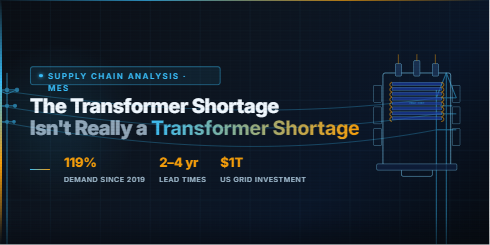
Lead times for 15 kV-class medium-voltage switchgear ran 52 to 80 weeks in mid-2026, and 78 to 104 weeks for 38 kV equipment, compared with roughly 24 weeks before the pandemic, according to procurement data from Terrapin Construction Group. Data centers are projected to account for about 68 percent of U.S. load growth through 2030, and that load passes through switchgear at Tier 2 of The 7 Tiers of a Data Center Build-Out
The vacuum interrupters, relays and instrument transformers are specialized OEM components. The rest of the cabinet is roughly 120 metal parts made by conventional processes, and each has a specification that determines whether the cabinet assembles, racks and carries its rated current as designed. This post covers those parts the same way Every Manufactured Part in a Data Center UPS
Switchgear Components by Family
| Component | Process and material | Specification that matters |
|---|---|---|
| Current path | ||
| Main copper busbars | Busbar fabrication; CNC machined C11000, silver or tin plated | 0.05 mm flatness at the joint face; plating measured at the contact face |
| Ground busbar | Busbar fabrication, C11000 | UL 467; bonding continuity across sections |
| Copper terminals and connectors | Forged, then machined | Grain flow follows the load path; plated at the joint face |
| Cable termination connectors | Forged and machined | Belleville hardware where aluminum cable lands on copper |
| Secondary disconnects | CNC machined, stamped | Plug-in contact geometry |
| Operating mechanism | ||
| Mechanism housing | A380 die cast, machined | ±0.05 mm bore to mounting face; ASTM E505 Level 2 in load-bearing areas |
| Trip latch and contact carrier | Investment cast 17-4PH H900 | ±0.13 mm on the first 25 mm; high-cycle fatigue |
| Operating shaft | Forged 4140 Q&T, machined | Straightness 0.1 mm per 100 mm |
| Arc chute assembly | Sheet metal, CNC | Interruption path geometry |
| Mounting brackets | Die cast or stamped, machined | Hole position relative to mechanism datums |
| Insulation supports | ||
| Insulator bushings | Composite or ceramic (specialist supply); machined mounting hardware | Creepage and clearance at the mount |
| Insulator supports | Die cast, machined | Creepage and clearance distances; edge condition |
| Enclosure and structure | ||
| Base frame and basepan | CNC machined, fabricated | Flatness carries the cabinet’s alignment |
| Internal mounting frame | Extruded 6005A or 6063, machined | Alignment of the breaker compartment |
| Breaker cradle and truck frame | Extruded, machined | Racking alignment through thousands of cycles |
| Enclosure panels, doors and control enclosure | Sheet metal; extruded framing | 1.2 mm minimum wall on extrusions |
| Door hinges and latches | Zinc die cast | Cycle-rated and corrosion-rated |
| Control and metering panel | Sheet metal, CNC | Cutout position for meters and relays |
| Ventilation louvers and screens | Stamped | Airflow balanced against the ingress rating |
| Wiring duct and harness tray | Extruded, stamped | Separation and strain relief |
| Cable entry plate | CNC machined | Sealing and EMI continuity |
| Lifting lugs | Forged | 4:1 design factor; certified per heat lot |
The Current Path
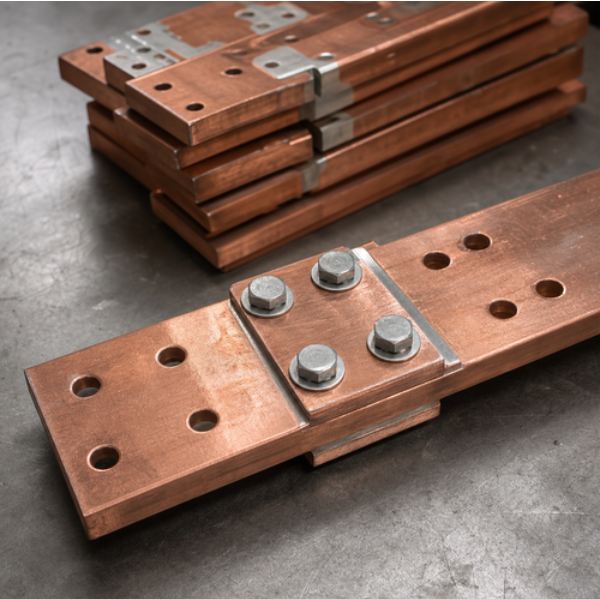
Main bus is C11000 copper at 100 percent IACS, silver or tin plated at the contact face. Thermal scans of loaded switchgear show the highest temperatures at bolted joints rather than mid-span, because current flows through the small fraction of the overlap in true metallic contact. Four specifications govern that: flatness at the joint face, surface finish of 1.6 to 3.2 µm Ra, contact pressure of 7 to 10 MPa, and plating thickness measured where current crosses.
Terminals are forged and then machined so the grain follows the part’s outline under a torqued connection. Where aluminum cable lands on a copper terminal, belleville hardware maintains clamp load as the aluminum relaxes.
The Operating Mechanism
The mechanism converts stored spring energy into contact motion, and it has to repeat that motion with consistent timing over the breaker’s mechanical life. IEC 62271-100 class M2 breakers are type-tested to 10,000 mechanical operations. The A380 die cast housing holds ±0.05 mm from bore to mounting face, the 17-4PH trip latch is investment cast for high-cycle fatigue, and the forged 4140 shaft is held to 0.1 mm per 100 mm straightness.
“On switchgear, the mechanism housing gets the closest review before tooling is cut,” says Brad Layne, Engineering Manager at MES. “A bore that’s out of position relative to the mounting face changes latch engagement, so we treat bore-to-face position as a critical characteristic and verify it on the CMM at first article.”
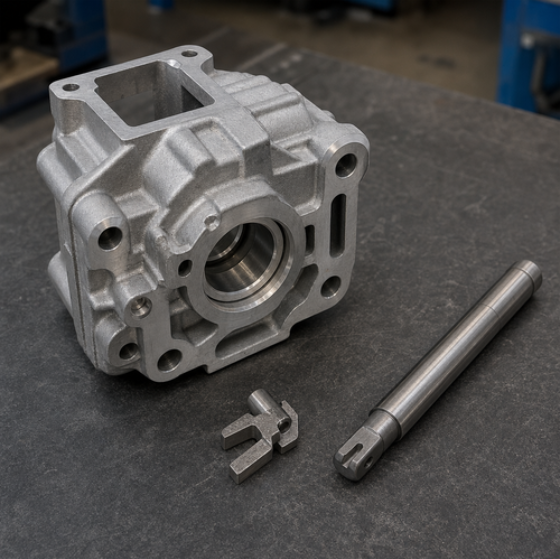
Porosity in a die cast housing isn’t detected by dimensional inspection, so the drawing should also specify ASTM E505 Level 2 in load-bearing areas.
Insulation Supports
Bushings and post insulators are composite or ceramic and come from specialist suppliers. Their mounting hardware and the die cast insulator supports are metal parts, and their geometry sets creepage and clearance distances between phases. Edge condition matters as well, because sharp edges on parts at line potential concentrate the electric field.
Enclosure and Structure
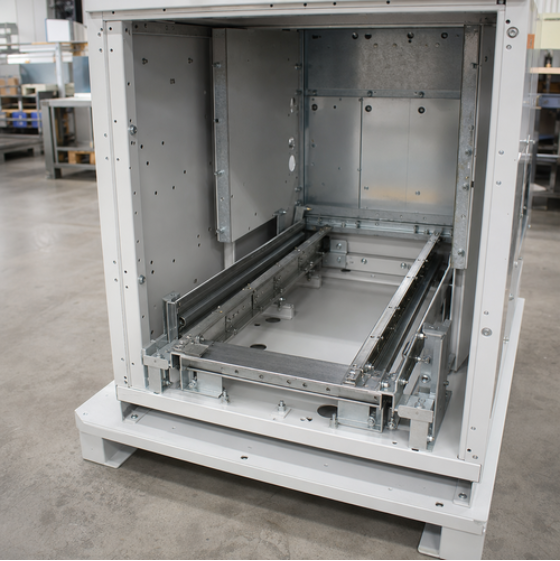
The largest group by count is structural. Base frame flatness propagates through the assembly: a frame out of flat puts the breaker cradle out of alignment, and a withdrawable breaker that racks in and out over its service life can bind or misalign at the stabs. The flatness requirement belongs on the base frame drawing as well as the cradle. Louvers balance airflow against the enclosure’s ingress rating, and the cable entry plate maintains sealing and EMI continuity where cables enter.
Seven Processes in One Cabinet
A UPS cabinet draws on four processes. Switchgear draws on seven: busbar fabrication for the main and ground bus, CNC machining for the base frame and cable entry plate, die casting for the mechanism housing and insulator supports, investment casting for the trip latch, forging for terminals, shaft and lifting lugs, extrusion for the internal frame and cradle, and sheet metal for the enclosure, louvers and arc chute. Sourced separately, each process adds a qualification cycle, an audit and a documentation set. Our transformers and switchgear page lists the medium-voltage switchgear components we provide.
Frequently Asked Questions
How many manufactured components are in medium-voltage switchgear?
Roughly 120 metal parts in a cabinet rated 630 A to 6,300 A at 12 kV to 38 kV, before vacuum interrupters, protection relays and instrument transformers are counted. They fall into four families: the current path, the operating mechanism, insulation supports, and the enclosure and structure.
What manufacturing processes are used to make switchgear components?
Seven: busbar fabrication, CNC machining, high-pressure die casting, investment casting, forging, aluminum extrusion and sheet metal fabrication. A UPS cabinet uses four of these, which makes switchgear the broader of the two assemblies.
What material is used for switchgear busbar?
C11000 electrolytic tough pitch copper at 100 percent IACS, machined and then silver or tin plated at the contact face. Joint performance depends on flatness, surface finish of 1.6 to 3.2 µm Ra, contact pressure of 7 to 10 MPa and plating thickness measured where current crosses.
Why is the switchgear mechanism housing die cast?
Die casting in A380 aluminum produces the housing’s complex geometry at production volume, with machining used for the bore and mounting face. The bore-to-face tolerance of ±0.05 mm controls latch engagement, and ASTM E505 Level 2 porosity limits apply in load-bearing areas.
How do switchgear components differ from UPS components?
Switchgear carries a higher part count, about 120 versus 90+, and a wider process mix, seven processes versus four. Switchgear also adds a mechanical operating mechanism and insulation supports, while a UPS adds thermal hardware and hot-swap module retention.
MES provides busbar and machined, cast, forged and extruded switchgear components through a qualified supplier base in eight countries, with MES engineering and quality staff inside those factories. Every drawing is reviewed before a tool is cut, and CMM verification is performed at source. Send a drawing for any part on this list and we’ll identify which specifications can be held as drawn and which can’t. Quotes take three to five business days.