How to Find the Casting That Could Delay Your 2027 Build: An 8-Point Checklist
Summary
As of mid-2026, medium-voltage switchgear was quoted at 52 to 104 weeks, and those builds still depend on a smaller pool of die casters and toolmakers. A casting is harder to move than most purchased parts because it’s tied to a tool, a process, and a qualification. If a supplier closes or can’t reach your 2027 volume, the replacement path can run longer than the time you have left. Use this 8-point checklist to review your castings part by part, see what each casting process requires when it moves, and decide which parts need a second source now.
KEY TAKEAWAYS
ARTICLE
In mid-2026, 15 kV switchgear was quoted at 52 to 80 weeks and 38 kV gear at 78 to 104 weeks, according to Terrapin Construction Group procurement data. Before the pandemic, the same equipment took about 24 weeks.
Quotes that long mean many 2027 production plans are already being set. They only hold if every part arrives on time, and one switchgear cabinet can require up to seven qualification cycles. The slowest one sets first shipment.
Castings deserve their own review because they’re among the hardest parts to move when a supplier can’t deliver.
Why Castings Are Harder to Move Than Other Parts
A machined bracket can often move to a new shop with a drawing and a first article. A casting depends on its tool and on process settings developed around that tool. To move it, you usually have to transfer the tool, prove it out on new equipment, and requalify the part.
The supply base has also gotten smaller. Pace Industries closed plants in Arkansas, Michigan, and Tennessee, and its customers have had to move tooling and requalify programs.
Tooling capacity is tight, too. Modern Casting reported that U.S. metal and plastic patternmaker jobs fell 69% between 2007 and 2023, citing Bureau of Labor Statistics data. One pattern shop’s lead time grew from 8 to 10 weeks to 12 to 14 weeks in 2025.
What Moving a Casting Requires by Process
What has to move, and what has to be proven again, depends on the process.
| Process | Typical Parts | What Has to Move | What Gets Proven Again |
|---|---|---|---|
| High-pressure die casting | Mechanism housings, insulator supports, enclosures | Hardened steel die, which must fit the new press | Dimensions, porosity, and leak tightness on sealed parts |
| Investment casting | Trip latches, contact carriers | Wax injection tool and shell process | Chemistry, heat treatment, and mechanical properties |
| Sand casting | Large housings and frames | Pattern and core boxes | Chemistry, mechanical properties, dimensions, and internal soundness |
Requirements vary by part, alloy, and customer. Confirm them with your quality team.
Porosity is the one that’s easiest to miss. Dimensional inspection doesn’t detect it, so a die cast housing from a new source can measure correctly and still need more validation.
The 8-Point Casting Risk Checklist
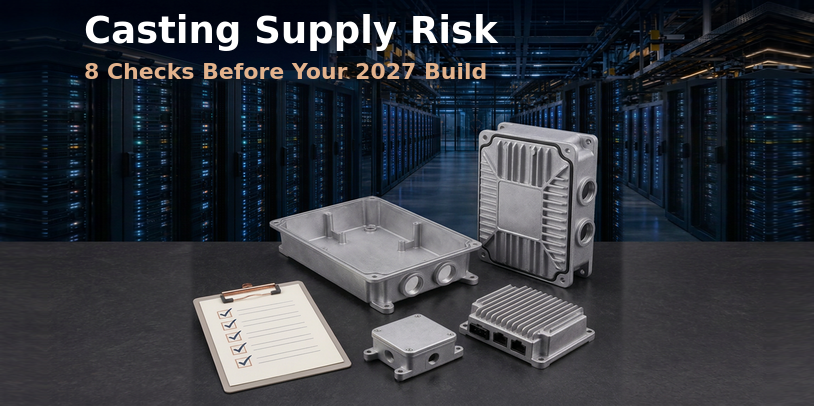
Run each casting through these eight checks and mark every row that applies.
| Check | Flag the Part If |
|---|---|
| 1. Source | Only one supplier is qualified to make it. |
| 2. Tool condition | You don’t have its usage count, repair history, or expected remaining life. |
| 3. Tool access | Your contract doesn’t confirm ownership or explain how the tool gets released. |
| 4. Volume | Your 2027 demand exceeds confirmed capacity, or the quoted lead time reflects older volumes. |
| 5. Qualification time | Moving and requalifying the part would take longer than the time before you need it. |
| 6. Downstream steps | Machining, plating, or finishing depends on one outside shop. |
| 7. Supplier health | The supplier’s ownership, finances, or staffing have changed, and nobody has reviewed the impact. |
| 8. Trade exposure | A tariff or country-of-origin rule could change its cost or eligibility. |
Start with the parts that have the most flags and no substitute in the build. Then match the fix to the flag.
How to Act on the Flags
Thermal Cycling: The Slow Way Insulation Fails
Dielectric strength gets specified. Adhesion through years of thermal cycling decides whether that dielectric strength is still there in year eight.
Copper and organic coatings expand at different rates, so every load cycle stresses the bond between them. A data center busbar cycles daily with load and seasonally with ambient, which adds up to thousands of cycles.
When a bonded coating separates, it leaves an air gap against the conductor, and in a high-field region, that gap is where partial discharge starts. Powder coat is most dependent on surface prep. Heat shrink grips instead of bonding, so it avoids debonding altogether.
Where thermal cycling is a real concern, specify:
A second tool costs money, and not every part justifies one. Safety stock can be the better fit for a stable design with predictable demand. It buys time, but it doesn’t remove the single-source risk.
Review Your Castings Before 2027 Volume Ramps
MES manages more than 1,500 die cast components across our sourcing network, with engineers and quality staff on site at supplier facilities.
Every drawing gets an engineering review before a tool is cut. On a casting that’s moving, we look at the tool and the qualification plan, too.
Send Us Your Casting List
Share your part numbers, 2027 volumes, and current suppliers. An MES engineer will tell you which parts we’d review first.
Frequently Asked Questions About Insulated Busbar
What makes a casting a supply risk?
A casting becomes a supply risk when it’s hard to replace and something threatens its current source. Common signs include a single qualified supplier, missing tool records, unconfirmed capacity for future volumes, and a requalification path longer than the time before parts are needed.
How long does it take to move a die casting tool to a new supplier?
There’s no standard timeline. It depends on the tool’s condition, whether it fits the new supplier’s press, what repairs it needs, and what your customer requires for requalification. Build the estimate from those items and confirm it with the new supplier and your quality team before you commit to a date.
Should buyers own their casting tools?
Ownership helps, but it doesn’t guarantee access. The contract should identify the tool, confirm who owns it, and explain how it gets released. Paying for a tool doesn’t replace written release terms.
Does every casting need a second source?
No. A second source adds tooling and qualification cost, so it makes the most sense for parts with several risk flags and no substitute. For lower-risk parts, a capacity commitment, better tool records, or safety stock may be enough.
What should a buyer ask a casting supplier for?
Ask for the tool’s usage count, repair history, and ownership documents. Also ask for confirmed capacity at your 2027 volume, a lead time based on that volume, and a list of outside shops used for machining, plating, or finishing.