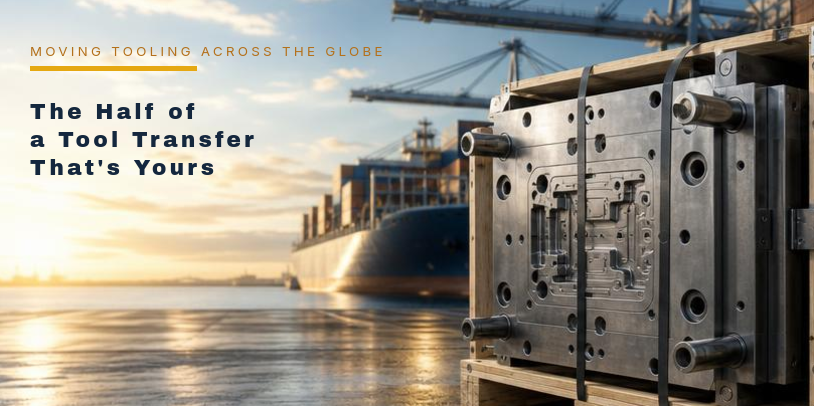
The Half of a Tool Transfer That’s Yours
SUMMARY
Tool transfers are usually discussed in engineering terms, but purchasing often controls the decisions that determine what happens when problems arise. Title, warranty, remaining tool life, rework scope, payment retention, IP rights, and customer requalification all need to be settled before shipment, while the tool is still on the supplier’s floor.
KEY TAKEAWAYS
- A tooling inspection tells you what’s wrong. Commercial controls determine who owns the problem, who pays for it, and what must happen before the tool moves.
- Payment retention until first-article approval keeps the outgoing supplier financially tied to the result after the tool leaves.
- Title, warranty, IP rights, rework, and requalification are all easier to settle before the tool leaves the supplier’s floor and the final payment is gone.
ARTICLE
Sit in on a tool transfer review and the conversation is almost entirely engineering. Heat checking, shut height, ejector stroke, insert projection. The purchasing leader who’s nominally accountable for the project often spends the meeting as a spectator to a discussion they can’t contribute to.
That’s an accident of vocabulary, not of substance. A lot of what causes a transfer to fail isn’t engineering. It’s commercial, and that part is yours. You don’t need to assess a die to be the person who made a transfer safe.
Here are seven controls worth insisting on before the tool moves.
ARTICLE
Sit in on a tool transfer review and the conversation is almost entirely engineering. Heat checking, shut height, ejector stroke, insert projection. The purchasing leader who’s nominally accountable for the project often spends the meeting as a spectator to a discussion they can’t contribute to.
That’s an accident of vocabulary, not of substance. A lot of what causes a transfer to fail isn’t engineering. It’s commercial, and that part is yours. You don’t need to assess a die to be the person who made a transfer safe.
Here are seven controls worth insisting on before the tool moves.
1. Confirm Title, Free of Liens or Claims
Tools get pledged against supplier financing. A sub-tier that built the tool on the outgoing supplier’s behalf may have a claim nobody has documented. An undocumented claim is likely to surface when a supplier is under financial pressure. Get written confirmation of clear ownership before anything is crated. It’s a one-paragraph request that can save a program.
2. Get a Written Warranty Position, Per Tool
Get a written position on this specific tool, given its actual condition, not a blanket statement in a frame agreement. On one of 12 tools our engineers recently inspected, the supplier declined to assure the warranty at all. A supplier who won’t warrant a tool is giving you valuable insight—but it’s only valuable while payment is still outstanding.
3. Ask for Remaining Life Against Rated Life
Every tool has a rated life in shots. What matters is remaining life given actual condition, which can be a very different number. A tool rated for 50,000 shots may have only a fraction of the life remaining on paper once heat checking, repairs, or other condition issues are considered. Get the shot count and remaining-life estimate in writing before you build a supply plan, or a price, around it.
4. Put the Rework Scope in Writing, Line by Line
Every open item needs a scope, owner, cost, and date, agreed by both parties. Verbal commitments fade once the tool ships. People change, priorities drop, and without a document there’s nothing left to reference.
5. Hold Back Payment Until First-Article Approval
Hold back part of the final payment until the tool produces approved first articles at the receiving plant—not when it arrives or gets installed. This is the one thing that keeps the outgoing supplier commercially invested in a tool that’s already left their building. No engineer can put this control in place; only purchasing can.
6. Secure an IP Release for Design and Part Data
Get an IP release covering the die design, 3D models, cooling and ejection layouts, and the component bill of material. The receiving supplier needs it to set the tool up and make spares. If you ever need to build a duplicate, that’s when you find out whether you had the rights. This is much easier to secure while the relationship is still active.
7. Confirm the Requalification Path Before You Set a Date
If a customer approves your process, moving a tool may require resubmission. Of the 12 tools our engineers inspected, six had PPAPs submitted with approval never received, meaning the baseline everyone assumed existed didn’t. Find that out before you commit a launch date.
Two More Controls that Function as Insurance
Two low-cost safeguards round this out:
- A timestamped photo record of the tool immediately before crating, which becomes your entire evidentiary basis for a transit claim.
- Marine insurance confirmed before departure, at a declared value that reflects what the tool is worth today.
You can’t personally verify a shut-off face, but you can be the person who confirmed clean title, got the warranty position in writing, retained payment through prove-out, and secured the IP.
Each one is easy while the tool is still on the outgoing supplier’s floor and there’s money you haven’t paid. Leverage is a wasting asset, so spend it before it expires.
Related: Nobody gets promoted for moving a tool · What a structured pre-transfer inspection finds
MES has moved roughly 240 tools since 2023 — 140 from China to Mexico, 80 within China, and 20 within India including large-tonnage die cast. We will inspect tooling you’re planning to move at no charge, including tools going to suppliers other than us.