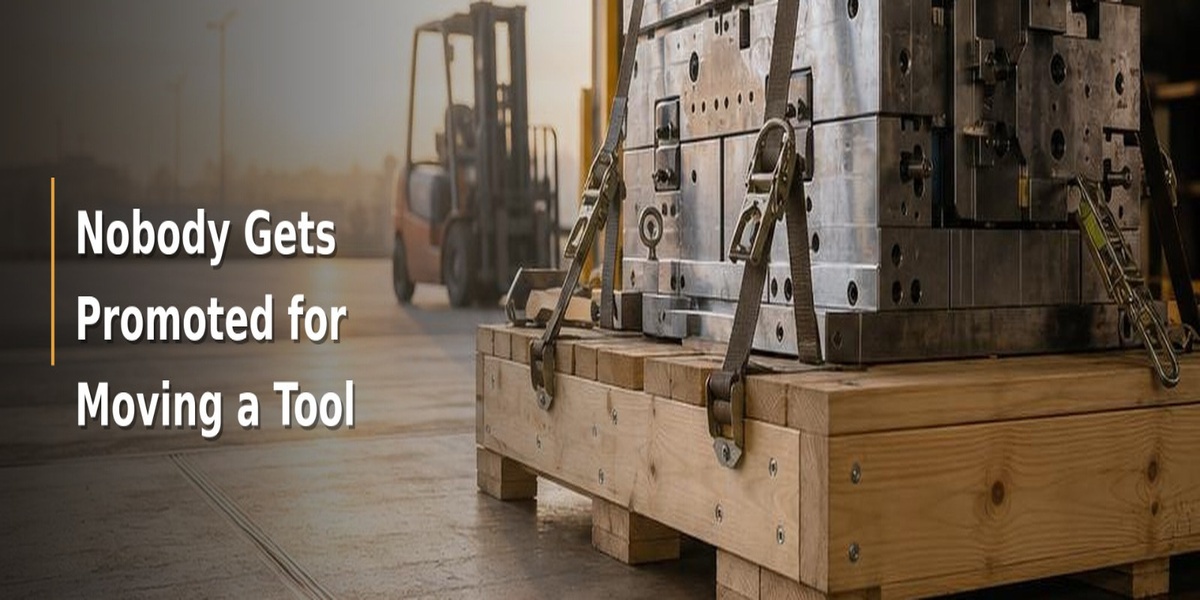
Nobody Gets Promoted for Moving a Tool
SUMMARY
Tooling transfers stall inside good companies not because the business case is weak, but because the risk of a failed move lands on whoever proposed it while the reward for a successful one gets absorbed into the budget. MES changes that calculation with a structured pre-transfer release process that checks the tool against the destination machine, documents every finding, and makes the release decision something the organization can review and share.
KEY TAKEAWAYS
- A successful transfer becomes next year's baseline. A failed one gets traced back to whoever proposed it.
- Delaying a move doesn't remove the risk. It hands the timing to someone else—usually your supplier.
- MES’s pre-transfer release gate checks the tool against where it’s going, documents what fails, and assigns open issues before the tool leaves the supplier’s floor.
ARTICLE
Somewhere in your organization there is a tool that should’ve moved two years ago.
Everyone agrees on the reasons. The supplier is a single point of failure, or the cost is out of market, or the footprint doesn’t make sense anymore. Someone built the business case and the savings hold up.
Then nothing happens.
Not because people are lazy or the analysis was wrong. But because the person who proposes the move takes on a risk that the company isn’t sharing with them.
Why Tooling Transfer Risk Falls on One Person
If the transfer goes well, the savings get absorbed into next year’s budget. Within 12 months it’s just the new baseline and nobody remembers who proposed it.
If the transfer goes badly, it goes badly with a name attached. A line down at the receiving plant. Air freight to cover a gap. A launch that slips a quarter and gets discussed at a level of the company that has never heard of this component before.
Someone will ask who decided to move the tool.
The people who don’t raise their hand aren’t timid. They’ve been in the room when a launch went wrong and watched what happened to whoever owned it.
Why Delaying Tooling Transfer Doesn’t Reduce Risk
Choosing not to move a tool feels like choosing no risk. It isn’t. It’s choosing a different risk, on a longer fuse, with no control over the timing.
Every quarter you don’t diversify, more of your volume depends on one supplier’s decisions about their own business: a plant closure, change of ownership, or decision to keep only the programs they like.
When that happens, the tool moves anyway, now under duress, on someone else’s date, with no time for diligence and no leverage, because the supplier has already decided they don’t want the work. That’s the dangerous version of a tool move—and it’s the one you get by waiting.
The Real Risk in a Tool Transfer: Moving without Evidence
Almost everything that goes wrong in a tool transfer was true about the tool before it shipped: a blocked cooling circuit, an ejector plate that never matched the receiving press, a checking gauge that everyone assumed existed, or a PPAP that was submitted but never approved.
None of that is transit damage or the receiving supplier’s fault. It was present, and findable, while the tool was still on the outgoing supplier’s floor, which is also the only moment someone else can be made to pay to fix it.
A packing list tells you what’s in the crate. A photo shows rust. A supplier declaration says the tool is in good order. None of that answers the question that matters: Will this tool run on that specific press and produce a part you can ship? That question is answerable, in days, by an engineer with the tool open, working through a defined list.
How a Pre-Transfer Release Gate Changes the Decision
Stop asking people to trust a judgment call. Instead, give them a record.
This is the job a structured pre-transfer release gate is built to do. On the programs we run, an engineer works the tool against 191 checks before anything ships. Every item is assessed, every finding photographed, and every open issue gets an owner, cost, and date. If you skip a checkbox, that counts as a fail, not a pass. Otherwise, the checklist is just for show.
Once that record exists, the person who proposed the transfer isn’t the one carrying the decision anymore. The evidence is.
That’s a different conversation to have when something goes wrong. It’s also a different conversation to have when you’re asking for approval, because a reviewer who can see the evidence can share the decision with you.
None of this requires you to personally assess heat checking on a die. It requires insisting someone does, and that the answer gets written down before the crate closes.
The tool that should have moved two years ago is still going to move. It’s worth deciding when, with the tool open in front of someone who does this for a living.
Related: What a structured pre-transfer inspection finds, with data from 12 tools · The half of a tool transfer that’s yours.
MES has moved roughly 240 tools since 2023 — 140 from China to Mexico, 80 within China, and 20 within India, including large-tonnage die cast. We’ll inspect tooling you’re planning to move at no charge, including tools going to suppliers other than us.